
Partner Experience
What is partner experience?

What is Partner Experience?
Partner experience is how clearly and usefully partners can access, understand, and act on a brand's programs, tools, content, incentives, communications, and support. This includes how they find resources, understand what to do, participate in programs, track progress, and engage across digital and operational touch points.
Why Partner Experience Matters
Partner experience matters because partners are more likely to participate when programs are easy to find, easy to understand, and easy to act on.
Organizations that invest in programs, incentives, and content often see those investments underperform when partners can't quickly find what's relevant to them or know what to do next.
A strong partner experience helps organizations:
- improve partner adoption and participation
- reduce friction across programs, portals, and workflows
- make incentives, content, and tools easier to access
- guide partners toward relevant actions
- support role-based and region-specific engagement
- reduce manual support and content distribution
- improve visibility into partner activity and readiness
- strengthen alignment across programs, messaging, and execution
Partner experience is not just about giving partners a login. It is about helping partners understand, engage, and act with confidence.
Common Challenges in Partner Experience
Partner experience breaks down when programs, tools, and communications are fragmented, giving partners no clear picture of what's available to them, what they qualify for, or what to do next.
Common challenges include:
- Generic portals — one-size-fits-all experiences fail to reflect different partner roles, regions, tiers, responsibilities, or program needs.
- Disconnected tools — partners may have to move across multiple systems to access incentives, content, training, claims, resources, and communications.
- Unclear next steps — partners may see information but not understand what action to take.
- Low adoption — portals, assets, incentives, or programs may go unused because partners do not see their relevance.
- Content overload — outdated, duplicated, or poorly organized content makes it harder for partners to find what matters.
- Inconsistent messaging — regional and partner-type differences can dilute brand alignment and create confusion.
- Limited visibility — internal teams may struggle to see which partners are engaging, what resources are being used, and where friction exists.
- Operational overhead — field, marketing, channel, and enablement teams may spend too much time manually distributing assets or answering repeat questions.
- Disconnected incentives — rebates, rewards, co-marketing funds, and promotions may not be surfaced where partners can easily understand or act on them.
Modern Approach to Partner Experience
The modern approach to partner experience gives partners a guided, role-based environment where relevant programs, tools, content, incentives, and actions are organized around what they need to do, not around how the brand's internal teams are structured.
This moves partner experience from passive access (a login and a content library) to active participation (clear next steps, relevant programs surfaced automatically, and incentives connected to action).
A stronger approach gives partners a guided, role-based environment where relevant programs, tools, content, incentives, resources, and actions are easier to access and easier to understand.
A modern partner experience helps organizations:
- organize access around partner roles, regions, tiers, and program participation
- surface relevant incentives, campaigns, content, and resources in one place
- guide partners toward high-value actions
- reduce friction across onboarding, enablement, claims, rewards, and program participation
- maintain governance over permissions, content, messaging, and eligibility
- support global consistency while allowing regional flexibility
- track engagement signals and improve the experience over time
The goal is not simply to centralize information. The goal is to help partners take the right action faster.
How Partner Experience Works
Partner experience operates across eight layers, from access and navigation through role-based relevance, program visibility, guided actions, content, incentive integration, governance, and analytics.
| Partner Experience Layer | What It Includes | Why It Matters |
|---|---|---|
| Access and Navigation | Login, hub structure, menus, search, pathways, and role-based entry points | Helps partners find what they need without unnecessary friction. |
| Role-Based Relevance | Content, programs, incentives, and tools tailored by role, region, tier, or relationship | Makes the experience more useful and reduces noise. |
| Program Visibility | Access to incentives, rebates, co-marketing funds, promotions, training, campaigns, and resources | Helps partners understand what is available and how to participate. |
| Guided Actions | Recommended next steps, tasks, calls to action, workflows, and program prompts | Moves the experience from passive access to active participation. |
| Content and Enablement | Sales tools, marketing assets, product information, training, certifications, and campaign materials | Supports readiness and execution. |
| Incentive and Program Integration | Rewards, rebates, claims, MDF, co-op, promotions, and performance tracking surfaced in the experience | Helps partners connect effort to value and outcomes. |
| Governance and Permissions | Visibility rules, content ownership, access control, localization, and approval processes | Maintains consistency, compliance, and brand alignment. |
| Analytics and Optimization | Engagement tracking, asset usage, program participation, and performance signals/td> | Helps teams understand what partners use and where improvement is needed. |
Partner Experience vs. Partner Portals, Partner Engagement, and Ecosystem Orchestration
Partner experience is related to partner portals, partner engagement, and ecosystem orchestration, but each concept plays a different role.
| Concept | Primary Focus | How It Relates to Partner Experience |
|---|---|---|
| Partner Experience | The quality and usability of how partners access, understand, and act across programs, tools, content, incentives, and support. | The outcome partners feel when interacting with the brand’s ecosystem. |
| Partner Portals | A digital access point for partner content, tools, forms, programs, and resources. | A portal can support partner experience, but partner experience is broader than the portal itself. |
| Partner Engagement | The level of partner participation, activity, and interaction. | Engagement is one result of a strong partner experience. |
| Ecosystem Orchestration | The coordination of programs, workflows, incentives, data, governance, and operations across the ecosystem. | Partner experience is how that coordination becomes visible and usable to partners. |
Partner experience is not reducible to portal design. A portal may be the access point, but the experience includes the relevance, clarity, guidance, and actionability of everything partners need to engage with the brand." (This is already your next paragraph — move it here as the table's closing context, and cut it from where it currently sits as a standalone paragraph.)
Core Partner Experience Terms
Role-Based Experience
A partner experience tailored to a participant’s role, region, tier, relationship, or program eligibility.
Guided Participation
The use of pathways, prompts, tasks, and relevant content to help partners understand what to do next.
Experience Hub
A structured digital hub designed to centralize partner access, guide action, and connect programs, content, incentives, and resources in one partner-facing experience.
Partner Engagement
The level of partner participation, activity, and interaction with programs, tools, incentives, and content.
Content Governance
The rules, ownership, permissions, and workflows used to keep partner-facing content accurate, relevant, and controlled.
Engagement Analytics
Data that shows how partners interact with content, programs, tools, and experiences.
Partner Readiness
The degree to which partners have the knowledge, tools, incentives, and resources needed to execute effectively.
Industry Nuance
Technology Ecosystems
Technology vendors may use partner experience to support resellers, MSPs, VARs, SIs, marketplace partners, and co-sell motions. A strong experience helps partners access enablement, incentives, campaigns, deal support, certifications, and relevant next steps based on their role and maturity.
Automotive and Dealer Networks
Automotive and aftermarket brands may focus partner experience on dealer access to programs, claims, promotions, loyalty initiatives, marketing tools, service lane activity, installer programs, and regional communications. The practical goal is easier participation and clearer execution.
Manufacturing and Distribution
Manufacturers may use partner experience to support distributors, contractors, installers, branch teams, and channel reps with product content, incentives, co-marketing programs, claims workflows, training, and localized execution resources.
Consumer Goods and Durable Products
Consumer and durable goods brands may use partner experience to help retailers, distributors, resellers, and installers access promotions, product assets, campaign materials, incentive programs, and performance resources across distributed sales channels.
Health and Life Sciences
Health and life sciences organizations may require more controlled access to programs, resources, and engagement workflows. In these environments, partner experience must balance usability with compliance, permissions, and documentation requirements.
How Experience Hub Supports Partner Experience
Experience Hub transforms fragmented partner portals, tools, and content into a unified experience where participants can access relevant programs, resources, incentives, and actions in one place.
A partner portal centralizes access. Experience Hub goes further — it determines whether that access is relevant, guided, and action-oriented for each partner based on their role, region, tier, or program participation. That distinction is what separates a static portal from a structured partner experience.
Experience Hub supports partner experience by helping organizations:
- design structured digital hubs by role, region, or program
- centralize access to content, tools, programs, and resources
- surface incentives, rebates, rewards, and promotions where partners can act on them
- guide partners toward relevant next steps
- manage permissions, eligibility, and visibility
- support localization and regional variation<
- monitor engagement and usage signals
The value is not just access. It helps organizations move from static portals to guided partner experiences that support participation, execution, and measurable engagement.
Partner Experience Checklist
Before building or improving a partner experience, teams should confirm:
- Which partner types, roles, regions, and tiers need different experiences
- What partners need to find, understand, and do most often
- Which programs, incentives, content, tools, and resources need to be surfaced
- Where partners currently experience friction or confusion
- Whether partners have clear next steps after logging in
- Whether incentives, claims, funds, campaigns, and enablement are easy to access
- Whether content is current, governed, and relevant by audience
- Whether permissions and eligibility rules are clear
- Whether regional or language requirements need to be supported
- How internal teams will maintain and update the experience
- How engagement, usage, participation, and performance will be measured
- How the experience will evolve as programs change
Related Concepts
- Experience Hub
- Partner Portals
- Partner Engagement
- Ecosystem Orchestration
- Channel Incentives Management
- Incentive Program Management
- Co-Marketing Funds
- B2B Rebates Management
- Loyalty & Rewards Programs
- Partner Lifecycle Management
- Incentive Automation
- Partner Enablement
- Partner Communications
- Program Governance
Simplify Program & Processes for Success
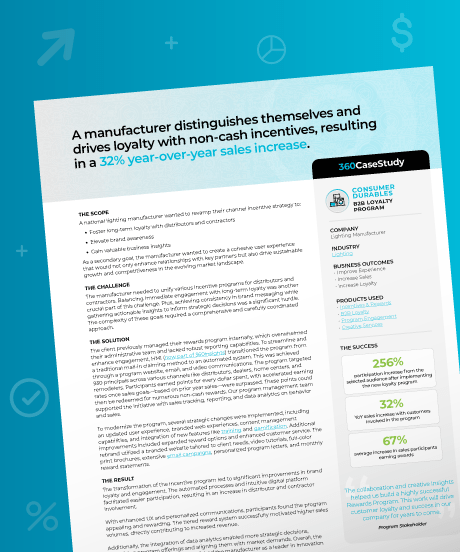
Case Study
Consumer Durables: Improving long-term loyalty through a cohesive user experience
A national lighting manufacturer wanted to switch up their channel incentive strategy in order to increase brand awareness and improve long-lasting relationships with distributors and contractors.
By creating a cohesive user experience - including the integration of training and gamification within this points-based rewards program and optimizing the engagement and comms strategy - this led to significant improvements in brand loyalty and increased revenue.
Learn how the program automations also improved the internal stakeholders reporting capabilities.
Frequently Asked Questions
Partner experience matters because partners are more likely to participate when programs, content, tools, and incentives are easy to find, easy to understand, and easy to act on.
No. A partner portal is a digital access point. Partner experience is broader and includes the full way partners access programs, understand next steps, engage with content, track incentives, complete workflows, and get support.
Partner experience describes the quality and usability of the partner-facing environment. Partner engagement describes the participation and activity that environment helps create.
Ecosystem orchestration is the broader coordination of programs, workflows, incentives, data, governance, and operations. Partner experience is how that coordination becomes visible and usable to partners.
Experience Hub is the 360insights solution that helps organizations create role-based digital hubs where partners and sellers can access relevant programs, content, incentives, tools, and actions.
Experience Hub improves partner experience by centralizing access, tailoring content and programs by role or region, guiding partners toward relevant actions, and giving teams visibility into engagement.
A good partner experience is clear, relevant, easy to navigate, role-based, governed, and action-oriented. Partners should know what applies to them, what to do next, and where to find the resources or programs they need.
Poor partner experience is often caused by generic portals, disconnected systems, outdated content, unclear messaging, inconsistent workflows, limited visibility, and too much manual support.
Companies can improve partner experience by simplifying navigation, personalizing access by role or region, surfacing relevant programs and incentives, governing content, guiding next steps, and measuring engagement over time.
Need More Information? Check Out the Resources Below!
Whether you're looking for industry-specific incentive strategies or want to increase your knowledge, our curated list of resources are designed to answer your most pressing questions.
%20copy%204.png?width=768&height=512&length=768&name=Blog_The%20Right%20Partner%20Experience%20Drives%20Partner%20Engagement_Feature%20Image%20(1160x580px)%20copy%204.png)
The Right Partner Experience Drives Partner Engagement
%20copy%204.png?width=768&height=512&length=768&name=Blog_How%20to%20Utilize%20Gamification%20to%20Boost%20Channel%20Partner%20Experience_Feature%20Image%20(1160x580px)%20copy%204.png)
How to Utilize Gamification to Boost Channel Partner Experience
%20copy.png?width=768&height=512&length=768&name=Videos_Optimizing%20Partner%20Engagement%20Series%20Part%203-%20Measuring%20Partner%20Engagement_Thumbnail%20(552x%20346)%20copy.png)