

Key Takeaways:
Not all SPIFF campaigns are created equal—Apple’s 1984 Christmas strategy outsold IBM’s PCjr by 10 to 1, despite offering only an $8 commission per unit.
- Apple’s success wasn’t about bigger payouts; it was about customer experience, marketing, and sales enablement:
- Marketing first: Apple educated buyers through ads and direct product comparisons.
- Live demo advantage: Apple staged showrooms with demo disks and interactive setups, while IBM left PCjr screens blank.
- Sales team empowerment: Clear, actionable SPIFF documentation (thanks to Charles Eicher) made participation easy.
- IBM learned too late—their reactive demo strategy couldn’t recover lost sales.
- Modern lesson: Winning SPIFF campaigns require intentional planning, customer-centric experiences, and digital incentive platforms for scalability.
- Actionable tips for brands today:
- Know your competition and highlight differentiators.
- Design SPIFFs that motivate sales teams with clarity and ease.
- Use incentive software to track, gamify, and optimize performance.
This may come as a shock—but not all SPIFF campaigns are created equal.
During the Christmas shopping season of 1984, two tech giants battled it out for home computer supremacy in the low-end consumer market. At the center of the fight—Apple’s //c and IBM's PCjr. In the end, it was Apple’s forward-thinking approach that would leave IBM in the dust.
Here’s how Apple created a SPIFF strategy for the ages that’s still relevant today.
The Challenge for Apple
It would be easy to assume Apple had a better SPIFF than IBM—but you’d be wrong.
For starters, the commission on every Apple //c was only $8. That’s right, no zeros on the end of that number. But that wasn’t the only uphill battle Apple had to climb.
Apple’s SPIFF campaign would have to win the battle on two fronts.
First, Apple had to contend with their much larger competitor—IBM.
Apple’s bitter rival entered the market just to erode their growing retail base. IBM was already a trusted brand for professionals. Now, IBM was content to duke it out with Apple in the low-end consumer market if it meant stealing some of their customer base.
Next, Apple had to compete against sales from large corporate accounts.
Many large accounts were eager to spend their budget before the December 31 deadline.
This meant easy sales with BIG commissions for sales teams. Apple had to make the //c demo virtually sell itself to gain traction against IBM and lucrative corporate deals. So that’s exactly what they did.
How Apple Set the Stage for Massive Success
It shouldn’t surprise you to know that Apple set the stage with an impressive marketing strategy. This commercial showcases how they looked to set themselves apart from their much bigger rival.
In true Apple fashion, they followed this up with great advertising. At the heart of it—showing how the //c provides the best home computer experience.


This culminated with providing a cohesive message that naturally flowed into the customer experience for their SPIFF program. It made it an easy lift for sales teams and a no-brainer for low-end consumers shopping for a home computer.
Real-World Example: How Apple Created Quick SPIFF Wins Against Steep Competition
During the ’84 Christmas shopping season, one retailer stood tall above the competition: ComputerLand.
Their chain of stores had a stranglehold on the market, with the Los Angeles store leading the way—thanks to one sales associate. His name? Charles Eicher.
After numerous calls from other locations asking how he was selling so many Apple //c computers, Eicher decided to do something brilliant.
He unknowingly created a clear, actionable, sales enablement SPIFF document:
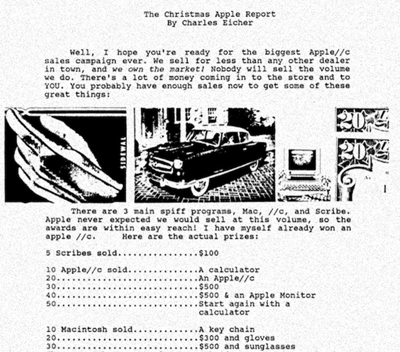
Source: Charles Eicher
Eicher’s genius approach to save himself time created a boon in Apple //c sales for ComputerLand. By clearly laying out the rules and prizes, it motivated teams to hop on this promotion despite its meager sales commissions—which was no small feat.
Thanks to Eicher’s document (and a branded showroom experience) Apple would dominate the Christmas shopping season despite stiff competition.
Dueling SPIFFs: How Apple Crushed Its Larger Rival—IBM
While their sales promotions and product offerings were virtually identical, one brand clearly edged out the other during the Christmas shopping season of 1984. And that was Apple.
Here’s why:
- Apple leaned on marketing
- They thought beyond just SPIFFs
- They created an environment for easy sales
- Apple thought about the customer experience first
This last point is the most crucial.
Buyers came into the store already aware of the Apple vs. IBM comparison.
It was a core element of Apple’s branding strategy. They recognized the uphill battle they had to climb for sales team buy-in due to larger competitors and corporate accounts. So, they made sure to spell it out in their commercials and advertisements.
They also did one other genius thing that IBM hadn’t considered.
It would be the one differentiator that would push Apple //c sales over the top.
How Apple Created a Live Demo Experience Like No Other
Apple knew that sales team buy-in was crucial for SPIFF success.
They also knew that despite their marketing efforts, outselling larger competitors and large corporate accounts wouldn’t be easy. They had to stand out with a superior live demo experience. So, they went about staging the showroom floor for easy sales.
ComputerLand placed the Apple //c and IBM PCjr side-by-side on the showroom floor.
This made it easy for the sales team to help customers comparison shop.
However, it would be Apple’s customer-centric approach that would help the //c sell itself. By implementing three strategies, they left IBM in the dust. Here’s how they did it:
- They set up empty //c boxes to draw the eye to the live demo station.
- They used a demo disk and kept it running on the screen.
- They allowed users to test out the product right away.
IBM didn’t consider staging, had no demo disk, and their computer was a blank screen.
It didn’t take the sales team long to figure out which product would be easier to hit their SPIFF sales target.
What IBM Realized Too Late
Top IBM executives caught wind of their crushing defeat halfway through the Christmas shopping season.
To stop the bleeding, they called ComputerLand to find out why they were losing to their smaller competitor. Rather than explaining it over the phone, Eicher asked if they would be willing to do a live side-by-side demo comparison.
After hours, the VP of IBM’s Personal Computer Division walked the showroom floor.
When Eicher approached the VP, he was fiddling with the //c. He only glanced at the PCjr for a moment. He asked if he could help him with something.
The VP responded that he’d like to demo the two computers.
Eicher walked him through dueling demos—creating a word processing document.
After the demos, the VP was still baffled. The two computers appeared seemingly even in comparison. He wondered why Apple’s //c was outselling them.
Eicher pointed out what the VP neglected to realize.
Apple had a demo disk up and running, while the PCjr had a blank screen.
It was Apple’s attention to detail that attracted people to the //c on the showroom floor. Over the weekend, IBM created a demo disk of their own, but by then, the damage had already been done.
How You Can Emulate Apple’s SPIFF Strategy
Chances are—you probably have stiff competition in your market.
In fact, some competitors may even be bigger, more well known, and have more trust in the market (similar to IBM). But that doesn’t mean you can’t destroy the moat they’ve built. It just takes intentional planning—and the right incentive software.
So, let’s take a look at a few ways you can emulate Apple’s brilliant SPIFF strategy.
1. Know Your Competition
Apple understood the steep competition that faced them in 1984—and they created an experience to stand out. Let’s look at what they did:
- They educated customers by comparing their product vs. competitors
- They followed up the comparison by spelling it out explicitly in their advertising
- They created a live demo experience to help them stand out on the showroom floor
- They made their product virtually sell itself, which made for easy SPIFF wins for sales teams
Apple leaned on smart advertising.
Their advertisements spelled out the subtle differences between them and their competitors. This made it easy for sales teams and consumers to compare the products. Then, they followed it up with a superior live demo experience.
How you can implement this strategy:
- Create intentional marketing materials
- Focus on solving pain points for your customer
- Show how your product is different from competitors
- Enable sales teams with the information to provide live demos
- Track SPIFF wins with an easy-to-use incentive software platform
By leveraging marketing materials, sales enablement documents, and incentive software, you can help stand out on the shelf.
2. Know Your Customer
Apple knew if they could get customers to play with the //c, they would win the sale.
So, they intentionally thought about the customer experience. They staged the showroom to make them stand out from their bigger competitor. Let’s look at how they did it:
- Apple stacked empty boxes of the //c
- The live demo disk made the //c irresistible
- The demo emulated the “feeling” of using the //c
This customer-centric approach made for easy SPIFF wins despite meager sales commissions.
How you can implement this strategy:
- Create sales collateral that educates your customers
- Incentivize sales enablement for brand preference and SPIFF wins
- Create SPIFF campaigns that speak to your customers and motivate sales teams
While you may not have a showroom floor, you can educate your sales teams to create unique customer experiences.
3. Know Your Sales Team
Apple had to battle larger competition and corporate accounts at the same time—that’s no small feat.
They also had very small commissions ($8). To this end, they realized they needed a SPIFF campaign that did the work for sales teams. So, they created an environment well-suited for easy sales.
Let’s look at how they did it:
- They educated buyers before they reached the showroom floor
- Apple compared the //c and PCjr for easy comparison shopping and sales
- They made their SPIFF easy to understand and easy to earn (thanks to Charles Eicher)
Chances are—you’re fighting for tough Q4 sales against steep competition (just like Apple).
You may be wondering how to steal back mindshare, wallet share, and brand preference as you enter 2026. The good news is with the right SPIFF strategy you can accomplish all your goals—and then some.
How you can implement this strategy:
- Analyze indirect selling processes from a customer lens
- Ask what the customer needs to make informed decisions
- Enable sales teams with information to answer customer questions
- Incentivize your indirect sales teams with training and motivational SPIFFs
In short, stop and consider how you can be the Charles Eicher for your brand.
Ask yourself what sales teams need for quick buy-in—and give it to them.
How the Right Incentive Platform Make SPIFFs Easier
Thankfully, we don’t have to tape elements onto paper to create Xeroxed SPIFF materials anymore.
Could you imagine?
Today, smart brands trust incentive software to digitally send sales enablement documents. They can even double down and use partner portals to incentivize training, store sales collateral in one place, and gamify the whole SPIFF experience. If your brand’s SPIFF strategy seems stuck in 1984, it may be time to consider a more 21st Century approach.
The 360insights Channel Incentive Platform combines incentives, fund management, rebates, go-to-market portals, and CPQ all under one SaaS solution. We’ve helped global brands build trust, run promotions, and improve their partner experience in automotive, consumer durables, life sciences, technology, media & telecom, and more.
Reach out today for a live demo and see what 360insights can do for your brand in 2026.
FAQ: Apple vs. IBM SPIFF Strategy


%20copy%205.png)