
Consistency,
Engagement,
Automation,
Personalization,
Interactive
—
A Power Management Manufacturer Generated $1.5 Million from Automated Welcome Emails
Ghost
Consistency
Engagement
Automation
Personalization
Interactive
A Power Management Manufacturer Generated $1.5 Million from Automated Welcome Emails
An email workflow triggered by each participant’s own behavior turned account activations into returning, claiming participants.

Key Takeaways
- A global power management and automation systems manufacturer generated $1.5 million through an automated email workflow triggered by participant behavior — 40% growth on prior year results, plus a 20% increase in redemption from the rewards catalog.
- The initial welcome email achieved a 48.6% open rate and a 34.7% click rate, with follow-up messages and reminders sent according to whether each participant interacted with that first email.
- Newly enrolled participants accounted for 32% of total claims and 50% of total revenue in the recorded period, which makes the window between activation and first claim the highest-value moment in the program.
Who is the Manufacturer?
A global manufacturer of power management and automation systems, operating in the electrical sector, running a B2B loyalty program for channel participants.
What was the manufacturer trying to achieve?
Two things: more account activations, and more consistent participation from the accounts already activated. The loyalty program was signing people up successfully. What it wasn’t doing was bringing them back.
Why do participants enroll in a loyalty program and never return?
This is the most common failure pattern in B2B loyalty, and it was exactly the problem here. The manufacturer had a solid record of program activation — participants were enrolling — but the return rate to the program website stayed low. Enrollment is a one-time action that takes a few minutes; returning is a habit that has to be built. Nothing in the program was doing the building.
A participant who activates an account and never comes back is worse than one who never enrolled, because the program carries the cost of their enrollment without ever seeing a claim.
What did 360insights implement?
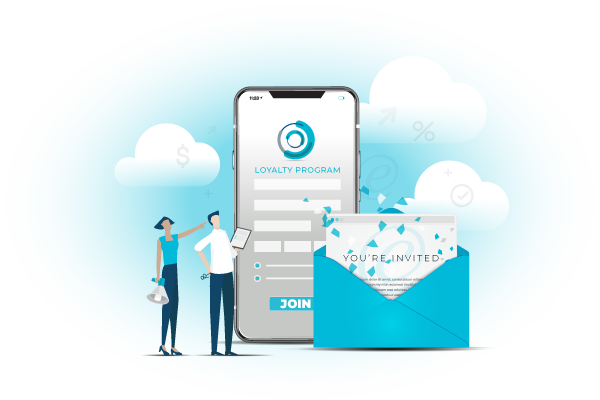
HMI, now part of 360insights, built an automated email workflow that responded to what each participant actually did rather than sending the same sequence to everyone.
- A welcome email dispatched the moment a participant activated their account
- Follow-up emails determined by how the participant interacted with that welcome email
- A thank-you email to encourage further engagement with the program
- Reminders sent when a participant had not interacted with the welcome email at all
The design principle is that the sequence branches. Participants who engaged got a different path from those who went quiet, which meant the program kept speaking to people in the state they were actually in.
What results did the automated email workflow deliver?
The campaign generated $1.5 million for the manufacturer — 40% growth on prior year results — along with a 20% increase in redemption from the rewards catalog.
The initial welcome email achieved a 48.6% open rate and a 34.7% click rate.
The finding worth dwelling on: newly enrolled participants were responsible for 32% of total claims and 50% of total revenue for the recorded period. New enrollees punched well above their share of the population, which is what makes the activation window worth automating in the first place.
Reviewed by Zoe Kelly on October 14th, 2026

Consumer Manufacturing
Program Engagement within B2B Loyalty Program
Company
Power Management Manufacturer
Industry
Business Outcomes
- Increase Engagement
- Make Programs Easier
- Improve Experience
- Increase Sales
Solutions Used
The Success
Frequently Asked Questions
Enrolling takes a few minutes and happens once; returning is a habit that has to be built deliberately. This manufacturer had a solid activation record but a low return rate to the program website, because nothing in the program reached participants after sign-up. Participants who activate and never come back cost the program their enrollment without ever generating a claim.
It’s a sequence where what a participant receives next depends on what they did with the last message, rather than following a fixed calendar. For this manufacturer, a welcome email went out at the moment of account activation, and subsequent emails were determined by how the participant interacted with it — including reminders for participants who had not interacted at all.
In this program, they received a reminder. The workflow treated no interaction as a signal rather than an endpoint, so participants who went quiet after activation got another prompt instead of being left alone. That branch matters, because the participants who ignore the first email are precisely the ones at risk of never returning.
In this program, substantially. Newly enrolled participants accounted for 32% of total claims but 50% of total revenue in the recorded period — a disproportionate share on both counts relative to their numbers. That ratio is the argument for investing in the activation-to-first-claim window specifically, rather than spreading engagement effort evenly across the whole participant base.
Here it did. Alongside the 48.6% open rate and 34.7% click rate on the welcome email, the manufacturer saw a 20% increase in redemption from the rewards catalog. Redemption is the measure that matters most, because points sitting unredeemed in a balance deliver no value to the participant and no proof of value to the program.