
Ghost
Drive Demand
Protect Margin
Understand Performance
Improve Visibility
Build Trust
Reduce Risk
Beyond the Redemption Rate
A guide to designing, scaling, governing, and measuring modern consumer promotions.
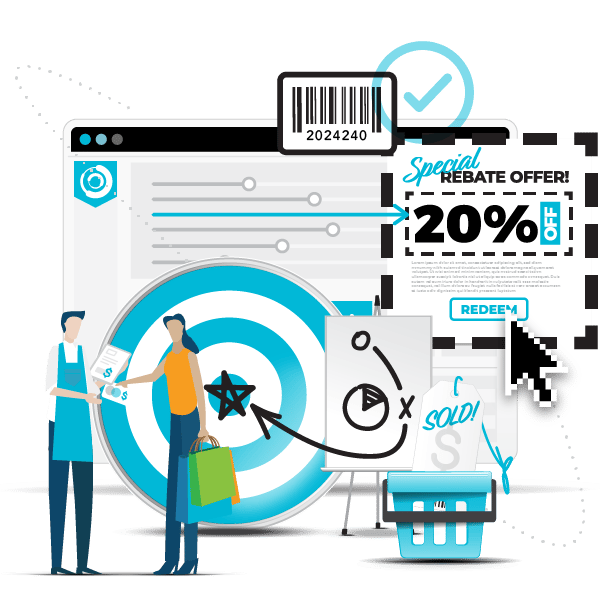




Consumer Promotions Quick Takeaways
- Consumer promotions influence end-customer action through rebates, cashback, purchase-based offers, rewards, and other promotional mechanisms.
- The right promotion type depends on the desired behavior, margin position, channel, consumer experience, and data requirements.
- Redemption volume alone does not establish incrementality or financial return.
- Modern promotion programs require coordination across marketing, finance, operations, risk, customer care, data, and channel teams.
- Connected promotion infrastructure can improve execution, consumer visibility, governance, reporting, and operational scale.
Bottom line: Consumer promotions become more valuable when brands manage the complete experience—from offer design and consumer participation through validation, reward delivery, reporting, and optimization.
A quick overview of what we’re covering:
Promotions Working?
Brands know promotions work, but few can prove by how much. While marketers track redemptions, CFOs demand audit-ready ROI. To survive, brands must bridge the gap between marketing metrics and financial reality.
What Consumer Promotions Actually Are
Every promotion trades off cost, conversion, and data. Instant discounts convert fast but cost the most; rebates yield rich data but convert slowly. Stop guessing margins—learn to balance the trade-offs.
Consumer Promotions vs Channel Incentives
Stop paying twice for a single sale. Mismanaging consumer pull and channel push means paying double on a transaction. Learn why separate teams and systems create costly, hidden leaks.
Who Touches a Promotion
Promotions cross nine departments, but fail in the seams between them. Marketing designs them, finance audits them, and customer care absorbs the friction. Stop siloed systems from leaking cash.
Legacy vs Modern Promotion Infrastructure
Legacy promo tools leak cash and distort data. Ditch manual checks, spreadsheets, and custom builds. Modern infrastructure connects the entire lifecycle—from setup to audit—for real, trusted ROI.
Bringing it All Together
Promotions are a financial mechanism, not just a marketing tactic. Scale your ROI by shifting from redemptions to real business outcomes, coordinating push-pull programs, and automating audit-ready governance.
-
Sections
Promotions Working?
Every brand knows its promotions work. Very few can say by how much.
Most brands can see whether a promotion generated activity. Far fewer can determine how much demand was incremental, what margin the promotion returned, or how confidently the result can be defended.
This is a structural problem. Consumer promotions grew up as a marketing tactic, funded from a marketing budget, measured by marketing metrics. Meanwhile the questions being asked of them have migrated to finance. A CFO does not want to know how many claims were processed. A CFO wants to know what the promotion returned, whether the money went where it was supposed to, and whether the number can survive an audit.
The promotions themselves have also gotten harder. What was once a mail-in rebate on a single product in a single country is now a portfolio of offers running across retailers, ecommerce, regions, currencies, and regulatory environments — often several at once, sometimes stacked on the same transaction without anyone noticing.
Running that well takes an understanding of which promotion type fits which objective, how consumer promotions interact with the incentives you pay your channel, and what infrastructure is required to make the resulting numbers trustworthy.
So let's start at the beginning.
What Consumer Promotions Actually Are
A consumer promotion is any incentive offered directly to an end customer to influence a purchase decision. That covers a wider range than most teams use. Each type behaves differently on cost, on conversion, and on what it tells you about your buyer.
Consumer promotions can take many forms. The right mix (and the technology or services required to support it) depends on the desired consumer action, channel environment, geography, and program design.
The Main Consumer Promotion Types
Consumer rebates and cashback. A claim-based reward provided after purchase. The consumer typically purchases at the established price, submits the required purchase information, and receives money or another defined reward. Claim-based rebates can protect headline price and create a direct consumer data relationship, but the post-purchase process may introduce more friction and delay than an immediate discount. Although unclaimed rewards can reduce realized promotional cost, breakage caused by a difficult or confusing claim experience may undermine consumer trust.
Instant rebates. The discount is applied at the point of sale. Instant rebates can reduce friction at the moment of purchase, but typically create higher realized promotional cost because eligible discounts are applied immediately. They may also provide less direct first-party consumer data unless connected to registration, loyalty, or transaction-level data capture. Compare the two approaches in detail.
Gift with purchase. A product or service bundled at no additional cost. Gift with purchase defends the price point, moves attach-rate inventory, and differentiates without inviting a straight price comparison. It underperforms with buyers who simply want the lowest number. See when to choose gift with purchase over cash.
Offer codes and promo codes. A control layer rather than a reward in itself. Codes determine who can access a given offer, which allows a brand to run an aggressive promotion in one region or for one segment without repricing everywhere.
Sweepstakes, contests, and gamified promotions. Lower cost per participant, strong engagement and data capture, and useful where the objective is awareness rather than immediate conversion. Regulatory requirements vary sharply by jurisdiction.
Loyalty and repeat-purchase offers. Rewards that accumulate rather than settle in one transaction, aimed at lifetime value rather than a single sale.
The Trade-off Nobody Escapes
Every promotion design balances multiple considerations: consumer immediacy, realized promotional cost, margin protection, data capture, operational complexity, and participant experience. No single mechanism optimizes all of them.
Instant rebates can reduce friction at the point of purchase, but they typically create a higher realized promotional cost and may provide less direct first-party consumer data. Claim-based rebates may offer greater cost control and richer consumer information, but their effectiveness depends heavily on awareness, ease of submission, processing speed, and reward delivery. Gift with purchase protects price and loses to cash with bargain-driven buyers.
Choosing well means knowing which axis matters for this objective, in this window, at this margin position — not which promotion the team ran last year.
The redemption rate is known to the decimal. The incremental margin is a guess wearing a suit.
Consumer Promotions vs Channel Incentives
Consumer promotions and channel incentives are frequently discussed as if they were the same discipline. They are not, and treating them as one is how brands end up paying twice for a single sale.
Consumer promotion primarily influence the end customer’s purchase or participation behavior. Channel incentives primarily influence the organizations and people responsible for stocking, recommending, selling, or supporting the product.
Similarities between consumer promotions and channel incentives
- Both draw on commercial investment and can affect the economics and realized margin of a sale.
- Both change behaviour by changing the economics of a decision.
- Both generate claims that must be validated before payment.
- Both create financial liability that finance must forecast and accrue.
- Both are vulnerable to duplicate, ineligible, and fraudulent claims.
Differences between consumer promotions and channel incentives
- Consumer promotions target the buyer; channel incentives target the seller.
- Consumer promotions generate demand; channel incentives generate availability and advocacy.
- Consumer promotions produce end-customer data; channel incentives produce partner performance data.
- Consumer promotions are usually owned by marketing; channel incentives usually by sales or channel teams.
- Consumer promotion claims come from individuals at scale; channel claims come from a known, finite set of partners.
- Consumer promotions typically run in defined windows; channel incentives often run continuously.
Why does this matter?
Because the two are almost always managed separately, and separation has costs that only appear when you look for them.
- Double payment on a single sale. A dealer SPIFF and a consumer rebate can both land on the same transaction. Two budgets, two systems, two teams, one unit moved. Nobody sees it because nobody is looking at both.
- Demand generated into a channel that can't convert it. Run a consumer promotion into a channel that isn't stocked or motivated, and the customer arrives ready to buy and is redirected by a salesperson earning a competitor's SPIFF. The promotion cost appears in your data; the lost sale does not.
- Sequencing failures on launch. Partner readiness must precede consumer demand. Reverse the order and you hand conversion to whoever was ready.
- Contradictory measurement. When consumer and channel programs report separately, the same incremental sale can be claimed twice in two different ROI stories, and finance believes neither.
- Invisible fraud patterns. Cross-program claiming — the same sale submitted to multiple programs with the purchase date shifted — is undetectable when the programs don't share claim data.
Coordination is difficult to sustain through planning alone when programs, transactions, claims, and reporting remain disconnected.
Who Touches a Promotion
A consumer promotion looks like a marketing decision and behaves like a cross-functional operation. Understanding who is involved — and what each function actually needs — explains most of why promotions underperform.
The traditional view
For years, a promotion involved three roles:
Brand or Product Marketing designed the offer and set the creative. A fulfilment house received claims, validated them by hand, and issued payment. Finance received a total at the end and accrued against it.
That model worked when volumes were low, the offer was singular, and the market was domestic. It does not survive contact with a global portfolio.
Who's actually involved now
Promotion or Program Managers. Own design, launch, and in-flight performance. Need to configure and change offers without a development cycle.
Brand and Product Marketing. Own the customer experience and the brand consequence of a difficult claim process. Need the redemption journey to reflect the brand it belongs to.
Finance and Controllers. Own accrual, liability, and reconciliation. Need forecastable breakage, verified payouts, and an audit trail that holds.
Sales and Channel Teams. Own the relationship with retailers and dealers. Need visibility into what consumer offers are live so channel and consumer programs don't collide.
Retail and Dealer Partners. Execute at the point of sale. Need offers that are simple to communicate and don't create a support burden for their staff.
Customer Care. Absorb every failure in the claim process. Need claim status visibility and the ability to resolve without escalation.
Legal and Compliance. Own regulatory exposure — payment, tax, privacy, promotional, and applicable financial-compliance requirements .
Risk and Audit. Help monitor financial exposure, control effectiveness, and potential leakage.
Data and Analytics. Own the answer to "did it work." Need transaction-level data connected to purchase, participant, and location.
The Consumer. Not a stakeholder in the org chart, but the participant whose experience ultimately determines whether the offer earns trust and drives the intended action. A claim process that frustrates people produces breakage that looks like savings on a spreadsheet and shows up later as brand damage you can't attribute.
Adopting a unified approach
Each of these functions can succeed individually while the promotion fails collectively.
Marketing can run a beautiful offer that finance can't accrue. Finance can tighten validation until legitimate consumers give up. Risk can hold claims for review until customer care drowns. Analytics can build a model on data that never captured which dealer drove the sale.
The failure is rarely in any one function. It is in the seams between them — and the seams are usually where one system ends and another begins. When offer configuration, claim validation, payment, care, and analytics sit in different environments, every handoff is a place where data degrades and accountability blurs.
The brands that run promotions well are not the ones with the best individual functions. They are the ones where those functions are looking at the same record.
Legacy vs Modern Promotion Infrastructure
Legacy approaches
Most consumer promotion operations still run on some combination of three things, each with a predictable failure mode.
- Heavily manual claim operations. Human review remains important for exceptions and higher-risk cases, but relying on manual handling for every claim increases cost, slows response times, and can create inconsistency during peak periods.
- Spreadsheets and disconnected point solutions. An offer built in one tool, claims in another, payments in a third, reporting assembled by hand. Every reconciliation is a project. No view exists in which a duplicate claim across two programs would be visible.
- Custom-built platforms. Attractive because the requirements seem simple. In practice, the initial build is the cheapest part — global payments, tax handling, fraud controls, regulatory change, and consumer support all become permanent internal obligations. The build-versus-buy case is rarely as close as it looks.
The common thread is that none of these produce a single connected record of an offer, its claims, its payments, and its outcome. Without that record, measurement is reconstruction — and reconstruction is why finance doesn't trust the number.
What modern promotion infrastructure requires
A capable consumer promotions environment covers the full lifecycle rather than a stage of it.
- Offer configuration and management. Build, change, and launch offers across products, regions, retailers, and currencies without a development cycle.
- Eligibility and code control. Restrict offers by segment, region, tier, or account so an aggressive promotion doesn't become the new list price.
- Claim capture and validation. Multiple submission paths with automated validation — serial number verification, purchase and eligibility validation, duplicate detection across programs.
- Fraud and risk controls. Configurable validation rules, duplicate detection, identity and submission checks, and review workflows that help identify suspicious or ineligible claims before payout.
- Global payments. Multi-currency, multi-method disbursement with the tax and regulatory handling each market requires.
- Consumer experience and care. Claim status visibility, responsive support, and a redemption journey that doesn't cost you the customer you just paid to acquire.
- Data integration. API and file-based connections to POS, ERP, CRM, and partner systems, so promotion data joins the rest of the business.
- Analytics and measurement. Reporting across participation, claims, validation, payout, and redemption activity, with the ability to support deeper performance and incrementality analysis when the required transaction, baseline, and comparison data are available.
- Governance and audit trail. Approval controls, reconciliation, and documentation that stands up to internal and external audit.
- Program engagement. Awareness and participation support, because an offer nobody knows about is an accrual with no upside.
A brand doesn't need all of these on day one. The required mix varies by program, but capability gaps tend to become more visible as promotion volume, geographic reach, data requirements, and governance expectations increase.
Bringing it All Together
Consumer promotions are both a demand-generation mechanism and a governed financial operation. Treating them as only one or the other limits their value. They are a financial mechanism that marketing happens to design — and the brands that treat them that way get compounding returns while everyone else runs offers and hopes.
Getting there means three shifts:
From redemptions to outcomes. Measure incremental margin, not claims processed. Decide the baseline before the offer launches, not after it closes.
From isolated programs to a coordinated mix. Consumer promotions and channel incentives are two directions of one strategy. Run them where they can see each other.
From processing to governance. Validation, audit trails, and fraud controls aren't overhead on a promotion. They are what makes the resulting number worth reporting.
That's what 360insights Consumer Promotions is built for.
What 360insights brings to consumer promotions
- Consumer Promotions: Configure and operate eligible cashback, rebate, and purchase-based offers across applicable markets, retailers, and currencies, with connected claim workflows, validation, fraud and risk controls, participant communication, reward delivery, and reporting.
- The Incentives Suite: Coordinate Consumer Promotions with complementary incentive programs such as B2B Rebates, Co-Marketing Funds, Loyalty, and Rewards to improve visibility across the broader incentive mix.
- Program Optimization & Analytics Services: Optional analytical support that helps organizations interpret program performance, identify optimization opportunities, and evaluate business impact using available program and client data.
- Program Operations & Delivery Services: Implementation support, claims processing, global rewards fulfillment, payments, and event and travel programs operated at scale.
- Platform Security: Compliance, governance, payment controls, financial approvals, reconciliation, and audit trails built for regulated global programs.
Frequently Asked Questions
Consumer promotions are marketing and incentive programs designed to influence consumer behavior by encouraging purchase, trial, repeat engagement, brand switching, basket growth, or another action tied to a product, brand, or campaign.
Examples include consumer rebates, cashback offers, gift with purchase promotions, discounts, limited-time offers, digital rewards, claims-based offers, and other promotional incentives.
Consumer rebates are one type of consumer promotion. A rebate provides money back after purchase, usually after the consumer submits proof of purchase or completes a required claim process.
Cashback incentives are similar to rebates because they provide money back after purchase. The difference is that cashback programs are often designed with a simpler, faster, more digital redemption experience.
A gift with purchase promotion gives consumers a free product, bonus item, bundle, or reward after they make a qualifying purchase or meet a defined purchase condition.
Companies use consumer promotions to drive demand, increase conversion, support launches, encourage trial, influence brand switching, raise basket size, improve sell-through, and measure campaign performance.
Consumer promotions are difficult to manage because offer rules, eligibility, submission workflows, fraud controls, fulfillment, and regional compliance requirements each add operational complexity — and errors in any one of them are visible to consumers.
Consumer promotions often underperform when the offer is unclear, the submission process is too complex, validation is inconsistent, fulfillment is delayed, or performance measurement is limited.
Companies can improve performance by designing clear offers, reducing submission friction, validating claims accurately, delivering rewards quickly, tracking performance, and using program data to optimize future promotions.
Good consumer promotion management starts with a clear offer — defined behavior, simple participation, and honest value communication. It then requires accurate validation, fraud controls, reliable fulfillment, and the reporting to measure and improve each program over time.