
Market Development Fund (MDF)
What is a market development fund?
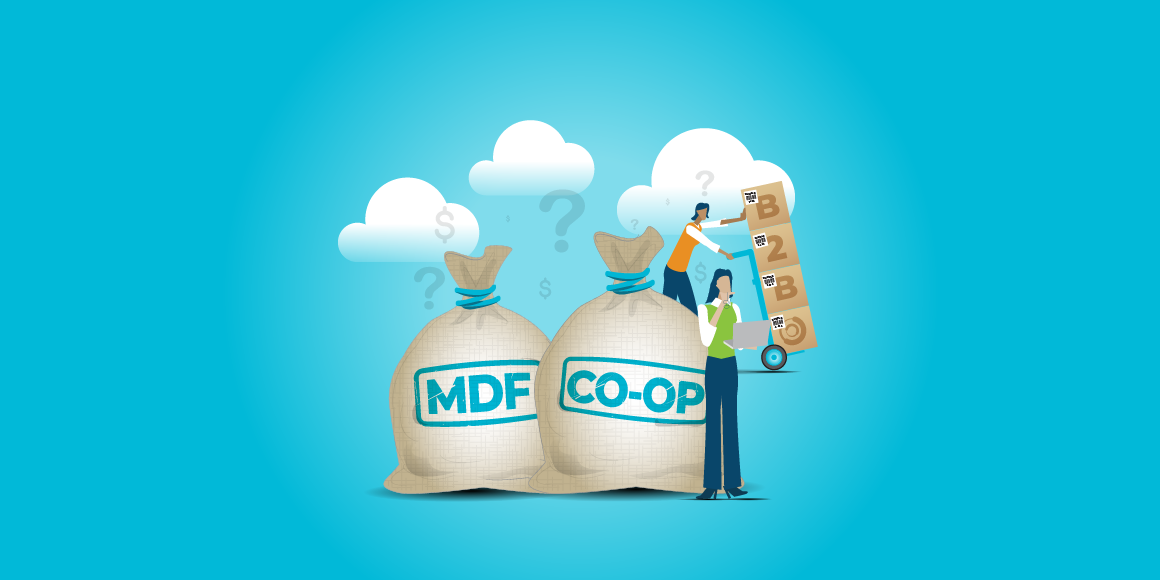
What is Co-Marketing Funds?
Co-marketing funds are budgets brands provide, allocate, or share with partners to support approved marketing activities such as campaigns, events, promotions, digital programs, and local demand generation. These programs may be called market development funds, MDF, co-op funds, business development funds, BDF, partner marketing funds, or marketing development funds depending on the organization, industry, and program structure.
What Co-Marketing Funds Include
Co-marketing funds is an umbrella category covering several related funding models — including MDF, co-op funds, BDF, and partner marketing funds — that organizations use to support approved partner marketing activities.
Buyers often use these terms interchangeably, but they are not always identical. The most important distinction is whether a program is brand-funded, partner-earned, shared, reimbursed after activity, or governed through a broader funds management process.
| Term | What It Usually Means |
|---|---|
| Market Development Funds (MDF) | Brand-funded budgets allocated to partners to support approved marketing or demand generation activities. |
| Co-Op Marketing Funds | Shared or earned marketing funds where partners typically receive reimbursement after approved activities are completed. |
| Business Development Funds (BDF) | Partner funding often used to support broader business development, pipeline generation, enablement, events, or strategic growth activities. |
| Partner Marketing Funds | A general term for budgets used to support partner-led marketing programs. |
| Marketing Funds | A broad buyer-facing term that may refer to MDF, co-op, BDF, or related partner funding programs. |
| Funds Management | The operational process used to allocate, approve, validate, reimburse, track, and report on funding programs. |
Why Co-Marketing Funds Matter
Co-marketing funds matter because they give partners financial support to run approved marketing activities while giving brands control over how partner-led campaigns, events, and local programs are funded, governed, and measured.
Organizations that manage these programs well can increase partner marketing participation, improve local campaign execution, support product launches, and connect partner marketing investment to measurable outcomes.
Strong co-marketing fund programs can help organizations:
- increase partner marketing participation
- improve local campaign execution
- support product launches and growth priorities
- improve partner engagement
- create clearer visibility into fund usage
- connect partner marketing investments to measurable outcomes
- reduce manual approval and reimbursement friction
Weak programs create operational and financial risk. If rules are unclear, workflows are manual, or partners cannot easily understand how to access funds, programs can suffer from low utilization, slow reimbursements, inconsistent execution, poor proof of performance, payment errors, and limited ROI visibility.
Common Challenges with Co-Marketing Funds
Co-marketing fund programs are difficult to manage because they span marketing, finance, operations, compliance, and external partners, creating approval bottlenecks, proof-of-performance gaps, and reimbursement friction. These challenges become more significant as programs scale across regions, partner types, fund models, and campaign types.
Common challenges include:
- Unclear eligibility rules — partners may not understand which activities qualify, when funds can be used, or what documentation is required.
- Low fund utilization — funds may go unused when partners lack visibility, guidance, or confidence in the approval process.
- Manual approvals — email-based or spreadsheet-based workflows slow down execution and create inconsistent decisions.
- Weak proof of performance — incomplete documentation makes it harder to validate whether funded activities were completed as approved.
- Slow reimbursement cycles — delayed payments create partner frustration and reduce trust in the program.
- Fragmented reporting — teams may know funds were allocated but not whether they drove campaign activity, engagement, pipeline, or revenue.
- Regional complexity — tax treatment, documentation standards, reimbursement norms, and compliance expectations can vary across markets.
- Disconnected systems — funding, claims, partner portals, marketing activity, and reporting may be managed in separate tools.
Modern Approach to Co-Marketing Funds
The modern approach to co-marketing fund management connects fund allocation, request submission, approval workflows, proof of performance, claim validation, reimbursement, partner visibility, and reporting into a single governed system.
Organizations are moving away from disconnected spreadsheets and manual approvals. This shift turns co-marketing funds from a budget administration process into a coordinated way to govern partner marketing execution and measure program outcomes.
A modern approach helps teams:
- define fund rules and eligible activities clearly
- give partners visibility into available funds
- simplify request and approval workflows
- validate proof of performance consistently
- manage reimbursements with stronger controls
- track fund utilization and partner participation
- measure performance across activities, partners, regions, and programs
- connect co-marketing funds to broader incentive and partner engagement strategies
How Co-Marketing Funds Work
Co-marketing fund management follows nine stages, from fund planning and allocation through partner activity execution, claim validation, reimbursement, and reporting.
| Stage | What Happens | Why It Matters |
|---|---|---|
| Fund Planning | Teams define the program strategy, eligible activities, funding rules, budgets, and business objectives. | Aligns funding to growth priorities, launch plans, partner tiers, or regional goals. |
| Fund Allocation | Budgets are assigned by partner, region, tier, product, campaign, or program. | Creates visibility into who has access to funds and why. |
| Request Submission | Partners submit planned activities for approval, such as events, campaigns, promotions, or digital programs. | Gives the brand control before funds are committed. |
| Approval Workflow | Requests are reviewed against eligibility, budget availability, timing, brand guidelines, and documentation requirements. | Reduces inconsistent decisions and off-policy spending. |
| Activity Execution | Partners run the approved marketing activity. | Turns funding into partner-led market execution. |
| Proof of Performance | Partners submit documentation showing the approved activity was completed. | Supports validation, reimbursement, and auditability. |
| Claim Validation | Documentation and spend are checked against program rules. | Reduces invalid claims, duplicate payments, and reimbursement errors. |
| Reimbursement or Settlement | Approved claims are reimbursed, credited, or settled. | Timely payment supports partner trust and participation. |
| Reporting and Optimization | Teams review utilization, participation, cycle time, claim accuracy, and performance outcomes. | Helps improve future funding strategy and program design. |
Co-Marketing Funds vs. MDF, Co-Op, BDF, Funds Management, and Rebates
Co-marketing funds are often discussed alongside MDF, co-op, BDF, funds management, and rebates. These concepts are related, but they play different roles.
| Concept | Primary Role | Timing | Best Used For |
|---|---|---|---|
| Co-Marketing Funds | Umbrella term for partner marketing funding programs | Varies by model | Partner-led campaigns, local marketing, events, and demand generation |
| Market Development Funds (MDF) | Brand-funded partner marketing support | Often allocated before or alongside planned activity | Campaign activation, launch support, and demand generation |
| Co-Op Marketing Funds | Shared or earned marketing funds | Often reimbursed after approved activity | Structured partner marketing programs tied to performance or contribution |
| Business Development Funds (BDF) | Partner funding for broader business development activity | Varies by program | Pipeline development, partner growth, strategic initiatives, and market expansion |
| Funds Management | Governance and operational control layer | Across the full fund lifecycle | Allocation, approvals, validation, reimbursement, reporting, and auditability |
| B2B Rebates | Performance-based financial incentives | Paid after performance is validated | Volume growth, product mix, loyalty, and partner performance |
Co-marketing funds support partner marketing execution. Rebates reward partner performance after thresholds are met. Funds management is the operating discipline that helps teams govern these programs accurately and at scale.
Core Co-Marketing Funds Terms
Fund Allocation
The process of assigning budgets to eligible partners, regions, campaigns, products, tiers, or time periods.
Eligible Activity
A marketing activity that qualifies for funding, such as an event, campaign, promotion, digital ad, content program, webinar, or local marketing initiative.
Prior Approval
The requirement that a partner receive approval before using funds for a planned activity.
Accrual
The process of earning or recognizing funds based on rules such as sales volume, purchase activity, partner tier, or program participation.
Proof of Performance
Documentation that shows the approved marketing activity was completed. Examples include invoices, screenshots, photos, campaign reports, event details, and attendance records.
Claim Submission
A partner request for reimbursement or settlement after an approved activity is completed.
Claim Validation
The process of confirming that the activity, spend, and documentation meet program rules.
Reimbursement
The payment, credit, or settlement issued to a partner after a claim is approved.
Fund Utilization
The percentage of allocated or earned funds that are actually used within a program, region, partner group, or time period.
Audit Trail
A record of fund allocation, requests, approvals, documentation, claims, reimbursements, and changes.
Program Governance
The rules, controls, ownership, and oversight used to ensure funds are used appropriately and measured consistently.
Industry Nuance
Technology Ecosystems
Technology vendors may use MDF, co-op, or BDF to support reseller campaigns, partner-led digital programs, webinars, event sponsorships, marketplace motions, and co-branded demand generation.
Manufacturing and Distribution
Manufacturers often use co-marketing funds to support distributor campaigns, contractor programs, branch activation, product education, and regional demand generation.
Automotive and Dealer
Networks Automotive and aftermarket brands may use co-marketing funds to support dealer promotions, local advertising, counter days, seasonal campaigns, installer programs, and regional market execution.
Consumer Durables and Appliances
Brands may use co-marketing funds to support showroom marketing, retail activation, seasonal promotions, local campaigns, and partner-led product awareness.
How Modern Platforms Support Co-Marketing Funds
Modern co-marketing fund platforms help organizations manage the full lifecycle of partner marketing funds in a more structured and scalable way.
Common capabilities include fund allocation, request submission, approval workflows, proof-of-performance validation, reimbursement management, partner visibility, reporting, and audit trails.
For organizations managing multiple partners, regions, fund types, and campaign models, this creates stronger control over marketing spend while making the experience easier for partners. It also helps finance, channel, marketing, and operations teams understand how funds are being used and where programs can be improved.
Co-Marketing Funds Checklist
Before launching or optimizing a co-marketing funds program, teams should confirm:
- What the funding program is designed to support
- Which partners, regions, tiers, products, or campaigns qualify
- Whether the program uses MDF, co-op, BDF, or another funding model
- How funds are allocated, earned, or requested
- Which marketing activities are eligible
- What approval steps are required before execution
- What proof of performance is needed
- How claims, reimbursements, disputes, and exceptions are handled
- How partners will see available funds, deadlines, rules, and status
- How fund utilization and marketing impact will be measured
- How finance, marketing, channel, and operations teams will monitor performance
- How the program will be optimized over time
Related Concepts
- Channel Incentives Management
- Incentive Program Management
- Market Development Funds
- Co-Op Marketing Funds
- Business Development Funds
- Funds Management
- Proof of Performance
- Claim Validation
- Partner Experience
- Partner Portals
- B2B Rebates Management
- Incentive Governance
We Build Partnerships that Last
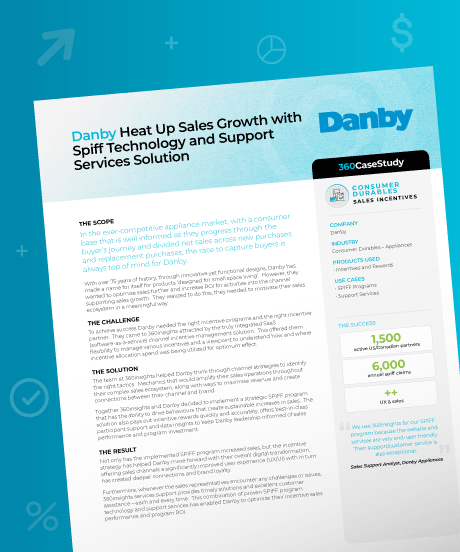
Case Study
Manufacturing: Danby Accelerating Performance with SPIFFs
Appliances manufacturer Danby was looking to motivate its sales ecosystem in a meaningful way.
Together with 360insights, a channel strategy was developed and the right tactics were identified that would amplify their sales operations throughout their complex sales ecosystem, along with ways to maximize revenue and create connections between their channel and brand.
Discover how, with the right incentives program in place and an awareness of how and where it was allocating incentive spend, Danby was able to effectively optimize that spend to increase ROI.
Frequently Asked Questions
Co-marketing funds are budgets brands provide, allocate, or share with partners to support approved marketing activities such as campaigns, events, promotions, digital programs, and local demand generation.
Not always. MDF is one common type of co-marketing fund. Co-marketing funds can also include co-op funds, BDF, partner marketing funds, or other funding models used to support partner-led marketing activity.
MDF is often brand-funded and allocated to partners to support planned marketing activities. Co-op funds are typically earned or shared based on partner performance and reimbursed after approved activities are completed.
Business Development Funds, or BDF, are partner funds often used to support broader business development activities such as pipeline generation, events, enablement, strategic growth initiatives, or partner-led market development.
Companies use co-marketing funds to extend market reach through partners, support local execution, improve partner engagement, drive demand generation, and align partner marketing activity with business priorities.
Co-marketing funds can be difficult to manage because they involve eligibility rules, fund allocation, partner requests, approval workflows, proof of performance, claim validation, reimbursement, reporting, and regional compliance requirements.
Funds often go unused when partners do not know funds are available, rules are unclear, submission processes are too complex, approvals are slow, or reimbursement requirements are difficult to navigate.
Common documentation includes invoices, receipts, screenshots, campaign reports, photos, event details, attendance records, proof of payment, or other evidence that the approved marketing activity was completed.
Companies can improve utilization by making funds easier to find, simplifying request workflows, clarifying eligible activities, speeding up approvals, improving partner visibility, and reducing manual reimbursement friction.
Co-marketing funds directly affect partner experience because partners need to understand what funds are available, how to request them, what activities qualify, what documentation is required, and when reimbursement will occur.
Co-marketing funds support approved partner marketing activity. Rebates reward partner performance after purchase, revenue, volume, growth, or other thresholds are met.
Good co-marketing fund management combines clear rules, visible fund balances, simple submission workflows, fast approvals, strong proof-of-performance validation, accurate reimbursement, auditability, and performance reporting.
Need More Information? Check Out the Resources Below!
Whether you're looking for industry-specific incentive strategies or want to increase your knowledge, our curated list of resources are designed to answer your most pressing questions.

State of Co-Marketing Funds Management

Beneath the Surface: The MDF/Co-Op Program Management Iceberg
