
Channel Incentives Management
What is Channel Incentives Management?

What is Channel Incentives Management
Channel incentives management is the process of designing, administering, validating, fulfilling, and measuring incentive programs across indirect sales channels. This includes partners, dealers, distributors, resellers, and contractors.
It helps organizations influence partner behavior, improve program participation, control incentive spend, and connect rewards to measurable business outcomes.
Why Channel Incentives Management Matters
Channel incentives management matters because it turns incentive ideas into governed, measurable programs that actually change partner behavior.
Organizations depend on channel partners to reach customers, move products, and support growth. But partner behavior does not change just because a program exists. Incentives guide that behavior by rewarding specific actions, outcomes, or performance milestones, such as selling more, completing training, or hitting volume targets.
Strong channel incentives management helps organizations:
- influence partner, dealer, distributor, reseller, or contractor behavior
- support revenue growth, product focus, and market expansion
- increase participation in priority programs
- improve visibility into incentive performance
- reduce manual administration and payout errors
- strengthen governance over spend, eligibility, validation, and fulfillment
- connect incentives to measurable business outcomes
Weak incentive management creates risk. Programs may become fragmented, hard to explain, difficult to measure, or expensive to operate. Partners may not understand how to participate. Finance teams may lack confidence in payout accuracy. Channel teams may struggle to prove which programs are working.
Common Challenges in Channel Incentives Programs
Channel incentive programs are difficult to manage because they span sales, marketing, finance, operations, and external partners, creating fragmentation, validation gaps, and governance risks.
Common challenges include:
- Fragmented incentive programs — rebates, SPIFFs, rewards, loyalty, promotions, and funds may be managed separately.
- Unclear qualification rules — partners may not understand what actions qualify, what thresholds apply, or how rewards are earned.
- Manual validation — teams may rely on spreadsheets, email approvals, manual claim checks, or disconnected transaction data.
- Payout errors and disputes — inaccurate calculations or weak validation can lead to overpayments, underpayments, duplicate payments, and partner frustration.
- Limited partner visibility — partners may not be able to see eligibility, progress, status, or expected rewards.
- Weak performance measurement — teams may know incentives were paid, but not whether they influenced the right behavior.
- Poor governance — finance, legal, compliance, and channel teams may lack consistent controls over rules, approvals, documentation, and audit trails.
- Regional complexity — tax treatment, documentation, payout methods, partner expectations, and compliance requirements may vary across markets.
- Disconnected partner experience — partners may have to navigate different portals, rules, processes, and timelines for different programs.
These challenges become more significant as organizations scale across multiple regions, partner types, products, and incentive models.
Modern Approach to Channel Incentives Management
The modern approach to channel incentives management connects strategy, rules, partner visibility, data capture, validation, payout workflows, and reporting into a single coordinated system.
Organizations are moving away from isolated programs and manual administration. This shift helps teams automate validation and payouts, give partners clearer visibility into earnings, reduce payout errors, and optimize programs based on participation and ROI.
How Channel Incentives Management Works
| Stage | What Happens | Why It Matters |
|---|---|---|
| Strategy and Program Design | Teams define the target behavior, audience, reward model, qualification rules, timing, and business objective. | Determines whether the incentive is aligned to the right outcome. |
| Program Launch and Communication | The incentive is communicated to partners, dealers, distributors, or other participants. | Clear communication improves awareness, participation, and trust. |
| Participant Action | Partners complete qualifying actions such as sales, purchases, claims, training, promotions, or threshold achievement./td> | This is the behavior the incentive is designed to influence. |
| Data Capture or Claim Submission | Activity is captured through POS data, invoices, claims, partner submissions, transactions, or system integrations. | Accurate data is required to validate eligibility and calculate rewards. |
| Qualification and Validation | Rules are applied to confirm eligibility, thresholds, timing, documentation, and supporting records. | Reduces errors, disputes, fraud, and invalid payouts. |
| Fulfillment or Payout | Approved rewards, rebates, credits, points, payments, or benefits are delivered. | Timely, accurate fulfillment supports partner trust and repeat participation. |
| Reporting and Optimization | Teams track participation, payout accuracy, performance lift, cost, ROI, and program trends. | Helps improve future incentive strategy and investment decisions. |
Types of Channel Incentives
Channel incentives can take several forms depending on the participant, behavior, and business objective.
| Incentive Type | What It Means | Best Used For |
|---|---|---|
| B2B Rebates | Retrospective incentives paid after partners meet purchase, revenue, growth, volume, or mix targets. | Driving partner growth, loyalty, product mix, and volume performance. |
| SPIFF Programs | Short-term incentives used to motivate individual sellers, reps, dealers, or channel participants. | Tactical sales pushes, product focus, launches, or short-term behavior change. |
| Loyalty and Rewards Programs | Points, rewards, status, or recognition programs designed to encourage ongoing engagement. | Sustained participation, repeat behavior, and partner loyalty. |
| Co-Marketing Funds | Partner marketing funds such as MDF, co-op, BDF, or marketing funds used to support approved activities. | Partner-led campaigns, demand generation, events, and local marketing execution. |
| Consumer Promotions | Consumer-facing offers such as rebates, cashback, gifts with purchase, or claims-based promotions. | Demand activation, conversion, sell-through, and promotional performance. |
| Sales Incentives | Incentives targeted at sellers, reps, dealer staff, or field teams. | Motivating individual sales behavior and execution focus. |
| Partner Performance Incentives | Rewards tied to program participation, certifications, training, pipeline activity, or strategic outcomes. | Encouraging broader partner engagement beyond sales alone. |
Channel Incentives Management vs. Related Concepts
Channel incentives management is related to incentives, rebates, promotions, partner experience, and ecosystem orchestration, but each concept plays a different role.
| Concept | Primary Focus | How It Relates to Channel Incentives Management |
|---|---|---|
| Incentives | Broad rewards or value mechanisms used to influence behavior | Channel incentives are incentive programs designed specifically for indirect sales channels and partner ecosystems. |
| B2B Rebates Management | Managing retrospective rebate programs based on partner performance or thresholds. | Rebates are one major type of channel incentive. |
| Incentive Program Management | Designing, operating, and optimizing incentive programs across audiences and use cases. | Channel incentives management is a channel-specific application of incentive program management. |
| Partner Experience | How partners interact with programs, portals, communications, claims, and rewards. | Strong incentives require a clear, usable partner experience. |
| Ecosystem Orchestration | Coordinating partner programs, incentives, experiences, workflows, and data across complex channels. | Channel incentives management is a major operational layer within ecosystem orchestration. |
| Co-Marketing Funds | Managing MDF, co-op, BDF, and partner marketing funds. | Funding programs may work alongside incentives to support partner-led execution. |
Core Channel Incentives Management Terms
Target Behavior
The specific action or outcome the incentive is designed to influence, such as sales growth, product focus, training completion, sell-through, or program participation.
Qualification Rules
The conditions a partner or participant must meet to earn the incentive.
Reward Structure
The format of the value being offered, such as cash, credit, points, rebates, rewards, merchandise, funds, or recognition.
Threshold
The level of performance, volume, revenue, product mix, or activity required to qualify.
Claim Submission
The process used when a partner or participant submits activity, documentation, or proof to receive an incentive.
Validation
The process of confirming that the participant met the rules and that the supporting data or documentation is accurate.
Fulfillment
The delivery of the incentive through payment, credit, points, rewards, rebates, or another approved method.
Payout Accuracy
The degree to which incentive payments or rewards are calculated and delivered correctly.
Participation Rate
The percentage of eligible partners or participants that engage with the incentive program.
Performance Lift
The measurable improvement in the target behavior tied to the incentive program.
Governance
The rules, controls, approvals, audit trails, and ownership structures used to manage incentive programs consistently.
ROI
The relationship between incentive investment and measurable outcomes such as sales growth, partner engagement, product mix, or program participation.
Industry Nuance
Technology Ecosystems
Technology vendors may use channel incentives to influence reseller, MSP, VAR, SI, distributor, or marketplace partner behavior. Programs may support co-sell activity, product focus, partner tier performance, training completion, marketplace participation, or pipeline growth.
Manufacturing and Distribution
Manufacturers often use incentives to influence distributor, contractor, dealer, or branch behavior. Programs may support product mix, volume targets, sell-through, pull-through, new product launches, or strategic account growth.
Automotive and Dealer Networks
Automotive and aftermarket brands may use channel incentives to motivate dealers, installers, distributors, and field teams. Programs may support seasonal campaigns, parts promotions, loyalty, counter sales, service lane activity, or preferred product behavior.
Consumer Goods and Durable Products
Consumer goods and durable product brands may use incentives across retailers, distributors, dealers, and consumer-facing campaigns. Programs may support sell-in, sell-through, promotions, product attachment, and local execution.
Health and Life Sciences
Incentive programs in regulated environments may require stronger controls around eligibility, documentation, approvals, and compliance. The goal is to support participation and performance while maintaining clear governance and auditability.
How Modern Platforms Support Channel Incentives Management
Modern channel incentives management platforms help organizations manage multiple incentive types in a more consistent, governed, and measurable way.
Common capabilities include:
- incentive program configuration
- partner and participant eligibility rules
- transaction, POS, invoice, or claim data capture
- rule-based qualification and validation
- rebate, reward, credit, or payout fulfillment
- partner visibility into status, progress, and earnings
- fraud prevention and duplicate claim controls
- audit trails and compliance workflows
- global and regional program support
- reporting, analytics, and program optimization
- services and operational support
For organizations managing complex partner ecosystems, the value comes from connecting incentive strategy, execution, partner experience, governance, and measurement. This helps teams reduce manual administration while giving partners clearer, more reliable ways to participate.
Channel Incentives Management Checklist
Before launching or optimizing a channel incentive program, teams should confirm:
- What behavior the incentive is designed to influence
- Which partner types, roles, regions, products, or transactions qualify
- Whether the incentive supports growth, product focus, loyalty, sell-through, training, or program participation
- Which reward structure is best suited to the audience and objective
- How eligibility rules, thresholds, timing, and exclusions are defined
- How activity will be captured through claims, POS data, invoices, transactions, or partner submissions
- How qualification and validation will be managed
- How payouts, rewards, credits, or rebates will be fulfilled
- How partners will see eligibility, progress, status, and earnings
- How disputes, exceptions, and adjustments will be handled
- Which governance, compliance, tax, or documentation requirements apply
- How program performance, cost, and ROI will be measured
- How the program will be optimized over time
Related Concepts
- Ecosystem Orchestration
- Incentive Program Management
- B2B Rebates Management
- Co-Marketing Funds
- Consumer Promotions
- Loyalty & Rewards Programs
- SPIFF Programs
- Incentive Automation
- Incentive Governance
- Claim Validation
- Proof of Performance
- Partner Experience
- Partner Portals
- Partner Engagement
Simplify Program & Processes for Success
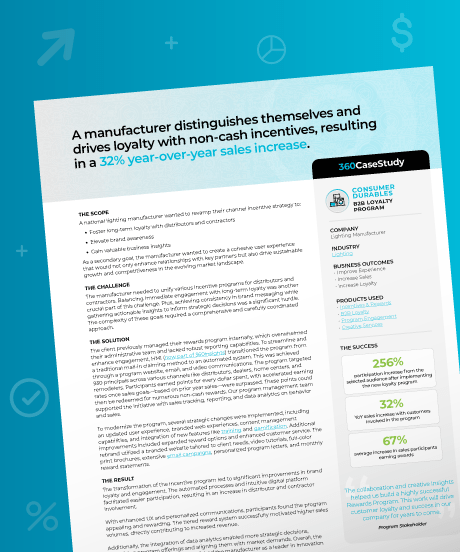
Case Study
Consumer Durables: Improving long-term loyalty through a cohesive user experience
A national lighting manufacturer wanted to switch up their channel incentive strategy in order to increase brand awareness and improve long-lasting relationships with distributors and contractors.
By creating a cohesive user experience - including the integration of training and gamification within this points-based rewards program and optimizing the engagement and comms strategy - this led to significant improvements in brand loyalty and increased revenue.
Learn how the program automations also improved the internal stakeholders reporting capabilities.
Frequently Asked Questions
Channel incentives management is the process of designing, managing, validating, fulfilling, and measuring incentive programs across partners, dealers, distributors, resellers, contractors, and other indirect sales channels.
Channel incentives are rewards, payments, funds, benefits, or recognition programs used to influence partner, dealer, distributor, reseller, or channel participant behavior.
Examples include B2B rebates, SPIFFs, loyalty and rewards programs, sales incentives, co-marketing funds, MDF, co-op funds, consumer promotions, cashback offers, and partner performance incentives.
It matters because incentive programs need clear rules, accurate validation, strong governance, reliable fulfillment, partner visibility, and measurable reporting to influence behavior effectively.
Rebates management focuses on one type of incentive: retrospective rebates based on purchase, revenue, growth, volume, or performance thresholds. Channel incentives management is broader and can include rebates, SPIFFs, rewards, co-marketing funds, promotions, and other incentive models.
Incentive program management is a broad discipline that can apply to consumers, employees, partners, sales teams, or other audiences. Channel incentives management focuses specifically on incentives used across indirect sales channels and partner ecosystems.
Channel incentives are difficult to manage because they often involve complex rules, multiple partner types, fragmented data, manual validation, payout workflows, regional requirements, and limited visibility into performance.
Companies can improve performance by clarifying target behaviors, simplifying participation, automating validation, improving partner visibility, tracking payout accuracy, and measuring outcomes by partner, product, region, or program.
Channel incentives directly affect partner experience because partners need to understand what they are eligible for, how to participate, how rewards are calculated, and when payouts or benefits will be delivered.
Good channel incentives management combines clear strategy, well-defined rules, accurate data capture, consistent validation, reliable fulfillment, strong governance, partner visibility, and measurable optimization.
Need More Information? Check Out the Resources Below!
Whether you're looking for industry-specific incentive strategies or want to increase your knowledge, our curated list of resources are designed to answer your most pressing questions.
.png?width=768&height=512&length=768&name=360-buildbuy_Hubspot-Thumbnail-(552-346px).png)
Build vs. Buy: Channel Incentives Management Platforms

Incentives Automation for Your Ecosystem
