
B2B Rebates Management
What is B2B Rebates Management?

What is B2B Rebates Management?
B2B rebates are retrospective incentives paid to distributors, dealers, resellers, contractors, or other business partners after they meet agreed purchase, revenue, volume, growth, mix, or performance targets. B2B rebates management is the process of designing, calculating, validating, accruing, and paying those rebates accurately across complex channel programs.
Why B2B Rebates Management Matters
B2B rebates matter because they give organizations a way to influence partner behavior without relying only on upfront discounts.
When managed well, rebates help organizations reward growth, encourage strategic product focus, protect margin, and create stronger visibility into channel performance. They can support partner loyalty, volume targets, product mix goals, sell-in activity, sell-through performance, and strategic account growth.
For organizations managing multiple products, regions, partners, and agreement structures, B2B rebate management becomes both a financial control discipline and a partner experience priority.
Common Challenges in B2B Rebate Programs
B2B rebate programs are difficult to manage because agreement logic is complex, transaction data is fragmented, and the margin for calculation error is high — making manual processes a direct financial risk.
Common challenges include:
- Complex agreement logic — rebate rules may vary by product, partner, region, tier, timeframe, transaction type, or performance threshold.
- Fragmented transaction data — POS, invoice, EDI, ERP, distributor, and partner-reported data may not align cleanly.
- Accrual uncertainty — finance teams may struggle to forecast rebate liabilities when earnings are not visible or consistently tracked.
- Calculation and validation errors — manual processes increase the risk of overpayments, underpayments, duplicate payments, and disputes.
- Slow payout cycles — delayed settlement can weaken partner trust and increase support burden.
- Limited partner visibility — partners may not understand eligibility, progress, expected earnings, or payout timing.
- Weak auditability — disconnected workflows make it harder to trace agreement terms, calculations, approvals, exceptions, and payments.
These challenges become more difficult to control as rebate programs scale across regions, product lines, partner types, and incentive models.
Modern Approach to B2B Rebate Management
The modern approach to B2B rebate management connects agreement design, transaction data, accrual tracking, validation, settlement, partner visibility, and reporting into one governed operating model.
This moves rebates from back-end payments managed in spreadsheets to structured incentive programs with shared visibility across finance, sales, channel, and operations teams.
Organizations increasingly need rebate programs that connect agreement design, transaction data, accrual tracking, validation, settlement, partner visibility, and reporting in one governed operating model.
A modern approach helps teams:
- configure rebate agreements consistently
- define clear eligibility, threshold, and payout rules
- ingest and validate transaction data
- calculate earnings based on agreed rules
- track accruals and liabilities
- manage exceptions, disputes, and adjustments
- give partners visibility into progress and payouts
- measure rebate performance by partner, product, region, or program.
This allows rebates to operate as structured incentive programs, not just back-end payments. It also helps finance, sales, channel, and operations teams work from a shared view of performance, risk, and program impact.
How B2B Rebate Management Works
| Stage | What Happens | Why It Matters |
|---|---|---|
| Agreement Design | Teams define eligibility, thresholds, products, dates, and payout rules. | Determines whether the rebate drives the right partner behavior. |
| Transaction Ingestion | Sales, POS, invoice, EDI, ERP, or partner data is captured. | Accurate data is required for qualification and calculation. |
| Qualification and Calculation | Rules are applied to determine earned rebates. | Protects margin and reduces overpayment or underpayment risk. |
| Accrual Tracking | Expected liabilities are tracked before payout. | Gives finance stronger visibility and forecasting control. |
| Validation and Reconciliation | Eligibility, records, and exceptions are reviewed. | Reduces disputes and improves payout confidence. |
| Settlement | Approved rebates are paid, credited, or settled. | Timely payout supports partner trust. |
| Reporting and Optimization | Performance, utilization, leakage, and ROI are analyzed. | Helps improve future rebate strategy. |
B2B Rebates vs. Discounts, SPAs, and Other Incentives
B2B rebates are often grouped with other channel incentives, pricing tools, and partner programs, but they play a distinct role.
| Model | Primary Purpose | Timings | Best Used For |
|---|---|---|---|
| B2B Rebates | Reward partner performance over time | After performance is validated | Growth, volume, mix, loyalty, and strategic behavior/td> |
| Discounts | Reduce price upfront | At purchase | Short-term purchase acceleration |
| Special Pricing Agreements | Support specific deals or account-level pricing | Transaction-specific | Competitive deals or named-account opportunities |
| SPIFFs | Motivate individual sellers or reps | After a defined action | Tactical sales pushes or product focus |
| MDF / Co-Op Funds | Support partner marketing activity | Before or after approved activity | Campaigns, events, and local demand generation |
The right model depends on the behavior the organization wants to influence, the timing of the incentive, the level of governance required, and how performance will be measured.
Core B2B Rebate Terms
Agreement Logic
The rules that define how a rebate is earned, calculated, validated, and paid.
Threshold
The required level of volume, revenue, growth, product mix, or performance needed to qualify for a rebate.
Rebate Accrual
The accounting recognition of expected rebate liability or earnings before final payout.
Transaction Ingestion
The process of bringing POS, invoice, EDI, ERP, or related data into the rebate management process.
Validation
The process used to confirm that activity met the rebate rules and supporting requirements.
Settlement
The payment, credit, or final payout of earned rebate value.
Leakage
Lost value caused by errors, overpayments, invalid claims, duplicate payments, weak controls, or missed reconciliation.
Partner Visibility
The ability for partners to see progress, expected earnings, eligibility, status, and payout information.
Audit Trail
A governed record of agreement rules, transactions, calculations, approvals, exceptions, changes, and payouts tied to the rebate.
Industry Nuance
Automotive and Dealer Networks
B2B rebates help manufacturers influence distributor, dealer, installer, and reseller behavior across volume goals, product mix priorities, seasonal campaigns, and strategic channel programs.
Manufacturing and Distribution
Manufacturers use rebates to reward distributor growth, contractor pull-through, branch performance, and strategic product adoption across regional or multi-tier channels.
Technology Ecosystems
Technology vendors use rebates to influence reseller behavior, reward partner tier performance, and coordinate incentives across indirect sales motions, particularly in multi-tier channel programs where upfront discounts create margin risk.
Consumer Durables and Appliances
Brands use B2B rebates to support retail sell-in, featured product movement, distribution goals, and partner-led market execution.
How Modern Platforms Support B2B Rebate Management
Modern rebate management platforms help organizations move from manual rebate administration to more governed, scalable workflows.
Common capabilities include agreement configuration, transaction data ingestion, rule-based calculation, accrual tracking, validation, settlement, partner visibility, and performance reporting.
For organizations managing complex channel programs, this creates stronger control over rebate spend while improving the partner experience and giving finance, sales, channel, and operations teams a shared view of program performance.
B2B Rebate Management Checklist
Before launching or optimizing a B2B rebate program, teams should confirm:
- What behavior the rebate is designed to influence
- Which partners, products, regions, and transactions qualify
- How thresholds, tiers, and payout rules are defined
- How transaction data will be captured and validated
- How accruals and liabilities will be tracked
- How disputes, exceptions, and adjustments will be handled
- How partners will see progress, eligibility, and payout status
- How finance, sales, channel, and operations teams will measure performance
- How the program will be optimized over time
Related Concepts
- Channel Incentives Management
- Incentive Program Management
- Rebate Automation
- Incentive Governance
- Claim Validation
- Partner Experience
- Market Development Funds
- SPIFF Programs
- Proof of Performance
Foster Long-Lasting Relationships to Drive Incremental Business
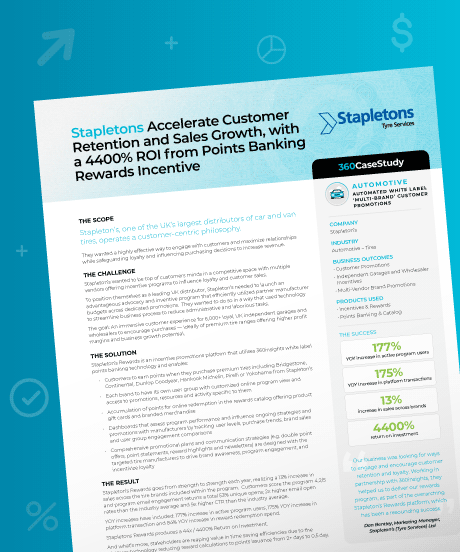
Case Study
Automotive: Accelerating customer retention and sales growth
Automotive distributor Stapletons, were looking for a highly effective way to engage with customers and maximize relationships while safeguarding loyalty and influencing purchasing decisions to increase revenue.
See how 360insights created an immersive incentive promotion platform, that rewarded independent garages and wholesalers for their purchases.
This award-winning program produces a 4400% return on investment and sees a 177% increase in active users YOY, increasing transactions by 175%.
Frequently Asked Questions
B2B rebates are incentives paid to business partners after they meet agreed purchase, revenue, volume, growth, mix, or performance targets.
B2B rebate management is the process of designing, tracking, calculating, validating, accruing, and paying rebate programs accurately across partners, products, regions, and agreements.
Discounts reduce price upfront. Rebates are earned after performance is validated, which allows organizations to reward specific outcomes while protecting margin earlier in the transaction.
B2B rebates can be difficult to manage because they often involve complex agreement rules, fragmented transaction data, accrual tracking, validation requirements, payout workflows, partner visibility, and auditability.
Finance, sales, channel, operations, legal, analytics, and partner teams may all be involved depending on the structure and complexity of the rebate program.
Companies can improve accuracy by standardizing agreement rules, connecting transaction data, automating calculations, validating eligibility, tracking accruals, and maintaining a clear audit trail.
B2B rebates help organizations influence partner growth, loyalty, product mix, sell-in, sell-through, and strategic account behavior.
Organizations should modernize rebate management when programs become difficult to calculate, audit, scale, reconcile, explain to partners, or connect to measurable business outcomes.
Need More Information? Check Out the Resources Below!
Whether you're looking for industry-specific incentive strategies or want to increase your knowledge, our curated list of resources are designed to answer your most pressing questions.

Engage Your B2B Channel by Targeting Point of Influence

CFO-Approved B2B Loyalty Programme Business Case (UK & EU)